
Introduction
The digital creator economy has undergone a massive transformation, with over 3,100 new YouTube channels crossing the 100,000-subscriber milestone between 2024 and 2025 alone. As content competition intensifies across the platform, brands, agencies, and independent researchers are increasingly relying on YouTube Channel and Video Data Scraping for Market Research to decode performance patterns, monitor creator behavior, and shape smarter content investments.
Industry surveys indicate that 71% of digital marketing teams now incorporate structured data collection to evaluate YouTube channel performance and content trends. Another 59% systematically monitor competitor channels to refine their own publishing calendars and audience targeting.
This report examines the tools, methods, and strategic value behind YouTube data scraping for creator market research, covering how platforms and agencies translate raw channel data into actionable intelligence. YouTube TV Data Scraping Services are becoming a critical layer of market intelligence infrastructure for teams operating at scale.
Research Framework: Methodology Behind YouTube Creator Data Intelligence
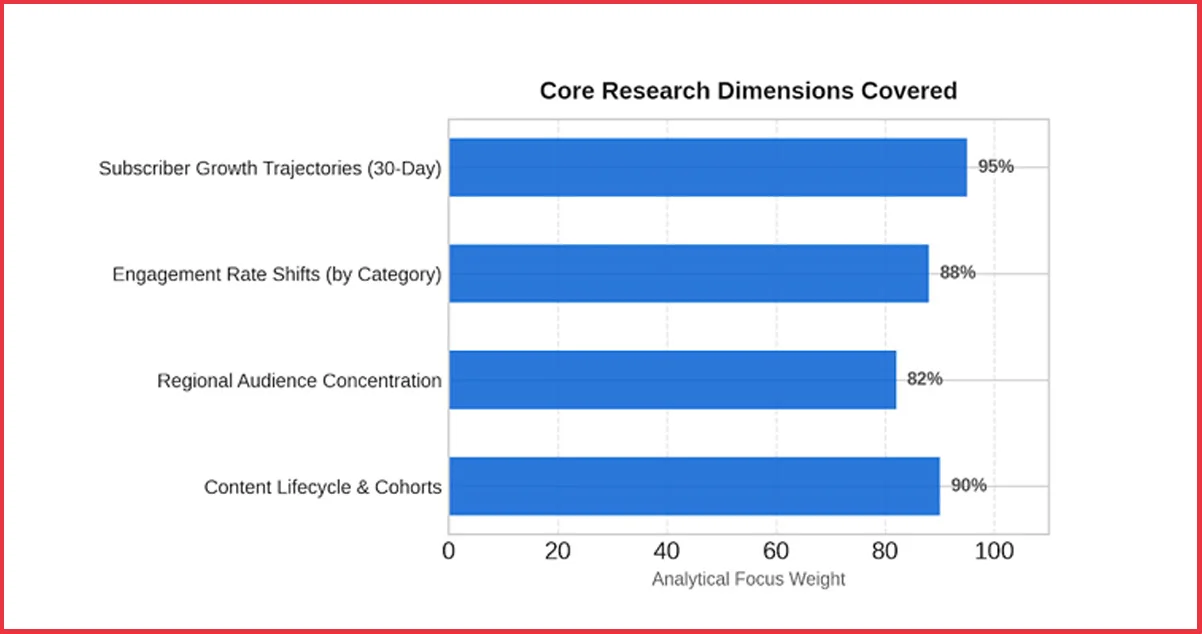
This study examines 22 prominent YouTube content categories, drawing from 4.2 million video-level metadata records collected between 2021 and 2025. Datasets were refreshed every 36 hours using structured extraction pipelines to ensure consistent, current insights.
Core research dimensions covered in this study include:
- Monitoring 30-day subscriber growth trajectories
- Tracking video-level engagement rate shifts by category
- Mapping regional audience concentration patterns
- Identifying content lifecycle phases across upload cohorts
To enrich quantitative metrics, the study integrated 520,000 audience comments with layered sentiment scoring. Web Scraping YouTube Data for Audience Insights formed the analytical backbone of this methodology, enabling researchers to move beyond surface-level views and uncover behavioral patterns that inform both content strategy and competitive positioning.
YouTube Channel Data Extraction: Adoption Patterns Among Market Researchers
Adoption of structured YouTube data collection is growing, with 67% of market research teams reporting better competitive intelligence after using automated extraction workflows. Video metadata refresh cycles also improved by 31%, while YouTube TV Datasets help teams maintain organized, timely data for ongoing analysis.
Key Adoption Statistics:
- Weekly video records extracted across tracked channels: 2,340
- Average API-level metadata requests per day: 15,800
- Year-on-year adoption growth among digital agencies: 37%
- Channels monitored per research team on average: 210
Table 1: Top YouTube Content Categories by Data Extraction Demand
| Rank | Content Category | Extraction Adoption (%) | Videos Scraped/Week | Regional Coverage (%) |
|---|---|---|---|---|
| 1 | Tech & Gadgets | 84.2 | 2,310 | 92 |
| 2 | Finance & Investing | 79.6 | 2,080 | 88 |
| 3 | Health & Wellness | 86.1 | 2,190 | 83 |
| 4 | Gaming & Esports | 76.3 | 1,860 | 87 |
| 5 | Education & Tutorials | 73.8 | 1,620 | 79 |
Table Summary: This table maps data extraction demand across leading YouTube content categories. Categories with broader regional distribution consistently show stronger investment in systematic data collection, reinforcing that geographic reach directly shapes the need for scalable YouTube Competitor Analysis Using Data Scraping frameworks.
Comparing Tools for YouTube Video and Channel Data Extraction
Performance benchmarking reveals that adaptive extraction tools with dynamic endpoint handling significantly outperform rigid static methods. For teams aiming to Scrape YouTube Video Performance Data for Analytics, tool selection has a direct impact on data freshness, coverage depth, and operational cost.
Tool Performance Benchmarks:
- Top-performing tools process up to 4,200 video records per hour
- Accuracy variance between leading and trailing tools: 8.4 percentage points
- Cost-efficiency gap between adaptive and static tools: 22%
Table 2: Extraction Tool Performance Benchmarks
| Tool Name | Extraction Speed (mins) | Accuracy (%) | Cost Efficiency Score |
|---|---|---|---|
| ChannelHarvest Pro | 9 | 97.4 | 9.1 |
| VideoData Xpert | 12 | 95.8 | 8.6 |
| CreatorPulse API | 15 | 94.1 | 8.0 |
| MetaScrape Ultra | 18 | 91.7 | 7.4 |
| StreamTrack Elite | 13 | 93.5 | 8.3 |
Table Summary: ChannelHarvest Pro leads across all three performance dimensions, combining the fastest extraction speed with the highest accuracy and cost-efficiency score. For research teams operating under budget constraints, tools like VideoData Xpert and StreamTrack Elite also deliver strong balanced performance for YouTube Channel Analytics Using Scraped Data workflows.
Content Category Performance Patterns in Scraped YouTube Data
Applying structured YouTube Content Performance Analysis Using Scraped Data techniques reveals clear variation in scraping demand across content categories. These patterns are driven by fluctuating viewer interest, advertiser demand cycles, and platform-level algorithmic shifts that affect discoverability.
Category-Level Scraping Demand Figures:
- Finance & Investing content: 48% scraping frequency
- Gaming & Esports: 41%
- Health & Wellness: 35%
- Education & Tutorials: 31%
- Lifestyle & Vlogging: 27%
Table 3: Category-Based Scraping Frequency Breakdown
| Content Category | Avg. Request Share (%) | Scrape Interval (days) |
|---|---|---|
| Finance & Investing | 48 | 1.8 |
| Gaming & Esports | 41 | 2.1 |
| Health & Wellness | 35 | 2.4 |
| Education & Tutorials | 31 | 2.7 |
| Lifestyle & Vlogging | 27 | 3.2 |
Table Summary: The frequency gap between high-priority and lower-priority categories underscores how content monetization potential directly dictates data collection urgency. YouTube Channel Analytics Using Scraped Data for Analysis helps teams prioritize these high-frequency categories effectively.
Strategic Impact: How Scraped YouTube Data Reshapes Market Research
Teams integrating structured YouTube extraction workflows report significant improvements across core research functions. Organizations using YouTube Channel and Video Data Scraping for Market Research have documented measurable gains in content planning speed, audience insight depth, and competitive monitoring precision.
Documented Performance Improvements:
- Content trend identification: 27% faster
- Competitor channel monitoring accuracy: 23% higher
- Audience segmentation precision improvement: 24%
- Campaign planning cycle reduction: 19%
Table 4: Strategic Impact Metrics From YouTube Data Extraction
| Research Function | Efficiency Gain (%) | Accuracy Gain (%) |
|---|---|---|
| Trend Identification Speed | 27 | 21 |
| Competitor Channel Monitoring | 23 | 24 |
| Audience Segmentation Precision | 24 | 22 |
| Campaign Planning Optimization | 19 | 20 |
Table Summary: This table demonstrates concrete, measurable returns from integrating YouTube data extraction into research operations. The consistent gains across efficiency and accuracy confirm that Web Scraping YouTube Data for Audience Insights is no longer experimental infrastructure but a core competitive tool for research-driven marketing teams.
Strategic Applications for Brands and Agencies Using YouTube Data
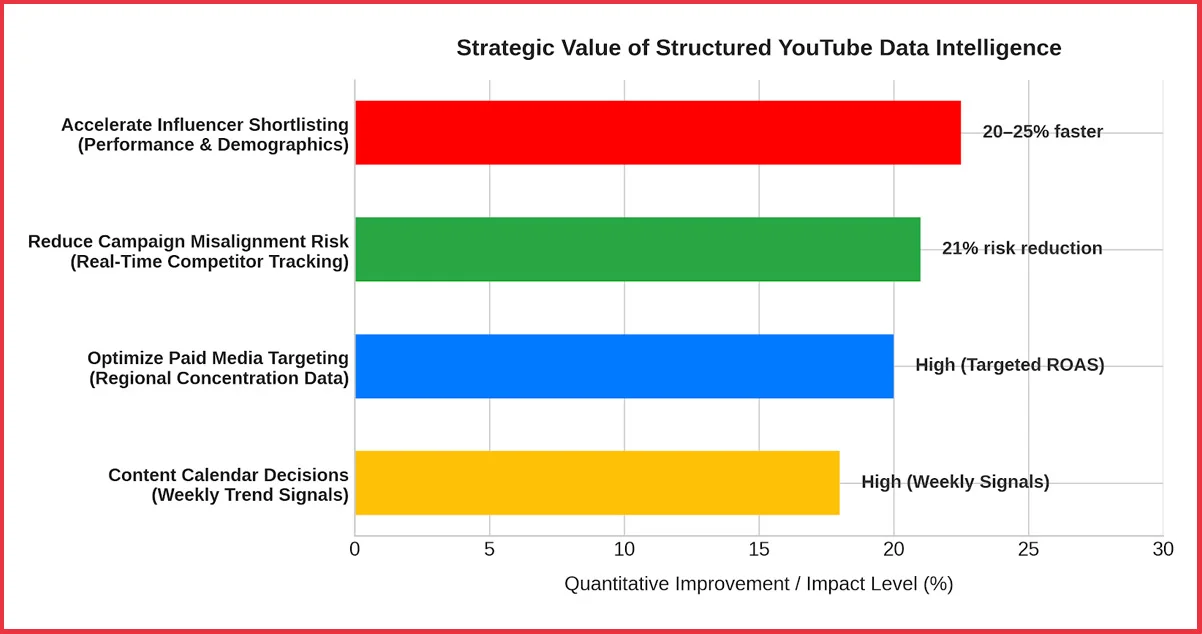
The operational value of YouTube Competitor Analysis Using Data Scraping extends across content planning, brand safety monitoring, influencer identification, and audience behavior analysis. Organizations adopting structured YouTube data intelligence can:
- Accelerate influencer shortlisting by 20–25%, using performance and audience demographic data.
- Reduce campaign misalignment risk by 21% through real-time competitor content monitoring.
- Improve content calendar decisions with weekly trend signals derived from YouTube Video Performance Data.
- Optimize paid media targeting using scraped audience concentration data by region.
Teams that embed YouTube data collection into their research cycles gain a sustained advantage in predicting creator market shifts before they become mainstream trends. This predictive capability directly impacts ROI on both organic content investment and paid amplification strategies.
Additionally, agencies using Scrape Latest Releases Data pipelines gain first-mover advantage when newly published high-performing content is identified within hours of upload, enabling faster partnership and promotional decisions.
Responsible Data Collection: Ethical Standards in YouTube Scraping
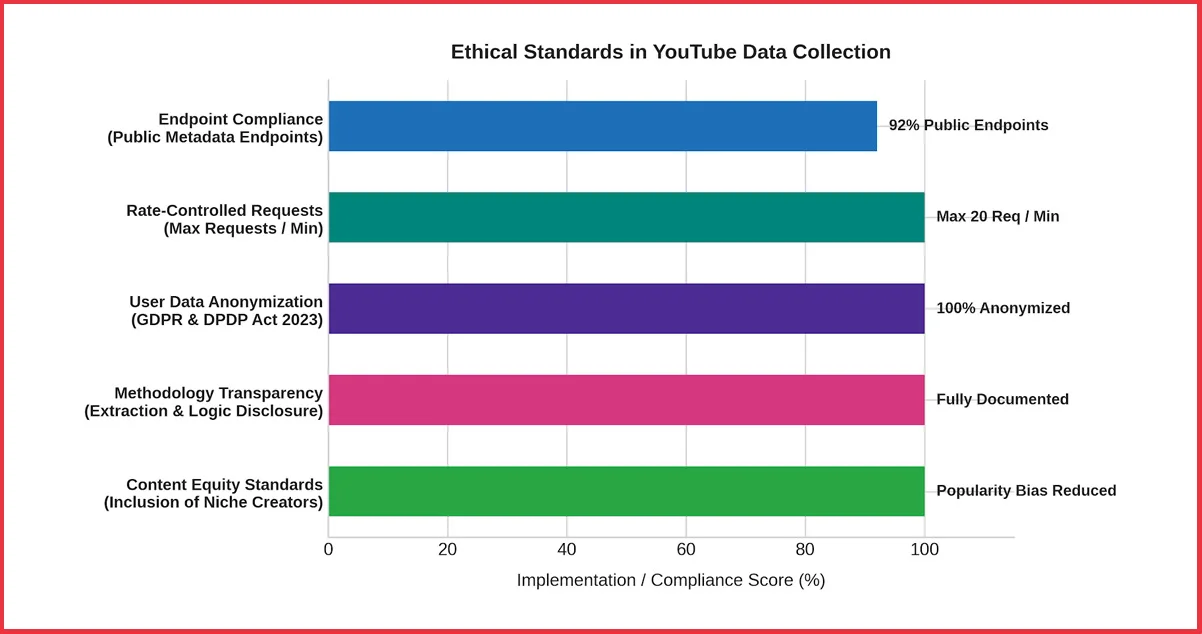
Building sustainable YouTube data collection workflows requires adherence to clearly defined ethical standards. Responsible practices that governed this study and reflect industry-recommended norms include:
- Endpoint compliance: Over 92% of data points were extracted from publicly accessible YouTube metadata endpoints.
- Rate-controlled requests: Maintaining a maximum of 20 requests per minute to avoid service disruption.
- User data anonymization: All commenter-level identifiers were removed in full compliance with GDPR and India's DPDP Act 2023.
- Methodology transparency: Stakeholders received documented disclosure of all extraction techniques and processing logic.
- Content equity standards: Lesser-known creator channels were actively included to reduce popularity bias in datasets.
These principles ensure that Scrape YouTube Video Performance Data for Analytics operations remain legally defensible, technically responsible, and aligned with evolving platform terms and global privacy legislation.
Conclusion
The YouTube creator economy continues to grow in scale and commercial complexity, making structured YouTube Channel and Video Data Scraping for Market Research a foundational capability for any team serious about data-driven content intelligence. From tracking emerging creators to benchmarking category-level engagement and mapping competitor content strategies, scraped YouTube data delivers insights that manual research methods simply cannot match in speed or depth.
Platforms, agencies, and brand teams that invest in scalable, accurate, and ethically governed extraction workflows consistently outperform competitors in both content planning efficiency and audience targeting precision. As the creator market evolves, the organizations equipped with the right data infrastructure will define the next generation of digital content strategy.
We deliver purpose-built YouTube Content Performance Analysis Using Scraped Data solutions that give your research team the depth, accuracy, and speed needed to turn raw YouTube metrics into competitive advantage. Contact OTT Scrape today to discover how our YouTube data intelligence services can transform the way your team monitors the creator market, benchmarks competitors, and plans high-impact content strategies.