
Introduction
OTT services increasingly depend on reliable channel inventories and accurate playlist information to maintain consistent viewing experiences. As streaming ecosystems expand across regions and providers, manually reviewing M3U files becomes difficult, particularly when channel lists change frequently or individual stream links stop responding. Our Web Scraping M3U Playlist Availability for OTT Analysis solution helped an OTT technology provider establish a structured process for collecting playlist information, checking channel conditions, and maintaining updated records across multiple sources.
The project was designed to give the client better visibility into channel-level conditions without adding repetitive operational work. Our Scrape Real-Time IPTV Playlist Monitoring System enabled recurring checks of playlist sources and helped identify unavailable, changed, or inconsistent stream entries. The collected information was organized into structured records containing relevant channel and source attributes, allowing technical teams to review changing conditions more efficiently and prioritize sources that required further investigation.
The resulting workflow also created a stronger foundation for OTT performance analysis and playlist management. Instead of depending on scattered manual observations, the client could work with continuously refreshed information and compare results across monitoring cycles. Our Web Scraping M3U Channel Data capabilities also supported IPTV Data Scraping by organizing channel-level information into a consistent structure. This gave the client a clearer view of stream conditions across different providers and regions.
The Client
The client was an OTT technology provider managing playlist information from numerous IPTV sources across different regions. Their existing process depended heavily on periodic manual reviews, making it difficult to maintain an updated view of channel availability. We implemented Web Scraping IPTV Channels Using M3U Playlists to organize channel names, stream URLs, identifiers, source details, and related playlist attributes into a consistent structure.
As the number of monitored playlists increased, the client needed a collection process that could operate consistently without requiring analysts to repeatedly inspect individual files. Our Automated M3U Playlist Data Scraping workflow enabled scheduled collection and helped maintain refreshed records across the selected sources. The process was configured around the client's preferred fields and monitoring intervals, allowing newly detected playlist entries and changes to be incorporated into the data pipeline without disrupting existing operations.
The solution was designed to support long-term monitoring rather than one-time playlist collection. It provided the client with a structured foundation for reviewing channel conditions, comparing records across monitoring cycles, and identifying sources that required closer attention. By creating a more organized data workflow, the project helped reduce repetitive checks while giving operational teams a clearer view of their growing IPTV channel inventory.
Key Challenges
The client's existing monitoring setup relied on repeated manual reviews of M3U files, making it difficult to maintain accurate channel information as sources expanded. With Real-Time M3U Playlist Review Data Scraping for IPTV incorporated into the workflow, the team could move toward more consistent validation and reduce the time spent checking individual playlist entries. This was particularly important when channels changed their stream endpoints or disappeared from source files without prior notice.
Another concern was the inconsistent structure of information received from different IPTV providers. Channel names, identifiers, URLs, languages, and supporting metadata were often presented differently, creating additional work during analysis. By introducing Web Scraping M3U Channel Data within the collection process, the client could bring these varied records into a more standardized format. This improved data consistency and made comparisons between sources easier for technical and analytics teams.
The client also struggled to identify recurring availability issues across monitoring cycles. Streams that worked during one review could become inaccessible later, while duplicate or outdated entries remained in the inventory. Limited historical visibility made it difficult to separate temporary interruptions from persistent source-level issues. By using a structured approach to Scrape TV Shows Data, the client could improve validation, track recurring issues, and maintain more reliable playlist management.
Key Solutions
We developed a flexible extraction framework that could process selected M3U sources at defined intervals while maintaining consistent data structures. Within this architecture, Web Scraping IPTV Channels Using M3U Playlists enabled the system to capture relevant channel attributes and organize them for downstream review. The workflow was designed to accommodate different playlist formats while allowing additional sources to be introduced as the client's requirements grew.
To minimize repetitive operational tasks, scheduled collection routines were incorporated into the overall pipeline. The use of Automated M3U Playlist Data Scraping allowed playlist records to be refreshed according to predefined monitoring cycles, giving the client a more current view of channel information. Validation rules were also applied during processing to identify changes, remove unnecessary duplication, and maintain cleaner records before delivery.
The framework was further configured to support availability-focused analysis and operational reporting. Through Real-Time M3U Playlist Review Data Scraping for IPTV, the client could review stream conditions more systematically and investigate records requiring attention. This created a scalable foundation for ongoing playlist assessment without requiring the team to manually review every source during each monitoring cycle.
Playlist Monitoring Data Metrics Across Key OTT Parameters
| Metric | Source 1 | Source 2 | Source 3 | Source 4 |
|---|---|---|---|---|
| Playlists | 1,250 | 980 | 1,475 | 1,120 |
| Channels | 18,600 | 14,850 | 22,400 | 16,750 |
| Active Streams (%) | 94.2 | 91.8 | 96.1 | 93.7 |
| Inactive Streams (%) | 5.8 | 8.2 | 3.9 | 6.3 |
| Validation Cycles | 24 | 24 | 24 | 24 |
| Response Time (ms) | 820 | 910 | 760 | 845 |
The structured dataset gave the client a clearer operational foundation for an IPTV Streaming Platform for Digital Broadcasting via Scraping, allowing playlist records to be compared across sources and monitoring cycles. The resulting metrics made it easier to identify availability variations and prioritize sources requiring further review.
The monitoring framework also improved consistency when handling large channel inventories and recurring validation tasks. With Web Scraping M3U Channel Data, the client could maintain organized records, evaluate stream conditions, and support ongoing OTT performance analysis without depending entirely on manual checks.
Advantages of Collecting Data Using OTT Scrape
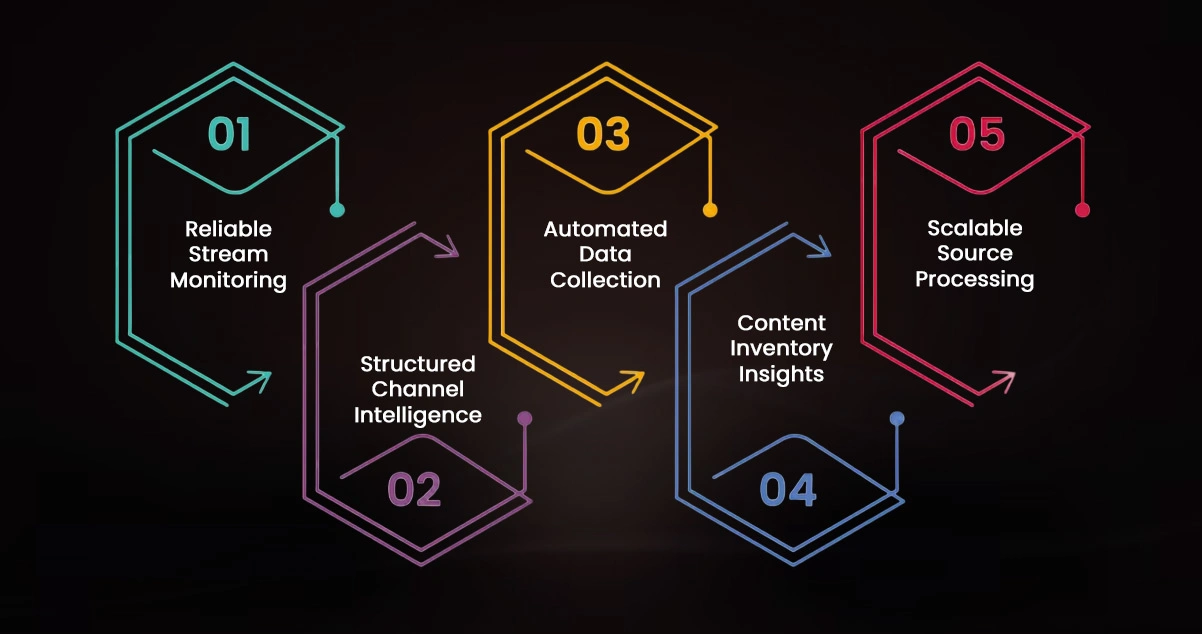
- Reliable Stream Monitoring
We continuously evaluate playlist conditions and channel accessibility, helping teams identify availability changes quickly while maintaining dependable records for ongoing OTT performance analysis. - Structured Channel Intelligence
Our solution organizes channel names, URLs, identifiers, regions, and availability details into consistent datasets, simplifying comparisons and supporting efficient playlist management across multiple sources. - Automated Data Collection
Recurring extraction workflows reduce repetitive checks while keeping playlist information refreshed, allowing teams to Automated M3U Playlist Data Scraping processes according to defined monitoring schedules. - Content Inventory Insights
Structured channel information supports content research and enables teams to Scrape Popular Shows Data while maintaining organized records for broader OTT catalog and programming analysis. - Scalable Source Processing
Our architecture accommodates growing playlist volumes and diverse sources, enabling teams to Web Scraping M3U Channel Data efficiently without redesigning their monitoring infrastructure.
Client's Testimonial
Conclusion
The project converted fragmented playlist checks into a structured and repeatable OTT monitoring workflow, giving the client better visibility into channel conditions and helping identify problematic sources more efficiently. Web Scraping M3U Playlist Availability for OTT Analysis supported consistent evaluation and clearer stream performance tracking.
The solution also established a dependable foundation for ongoing playlist assessment and stability reporting through Web Scraping M3U Channel Data. This approach can support scalable monitoring as playlist volumes and source requirements grow. Contact OTT Scrape today to discuss your OTT playlist monitoring requirements and build a solution aligned with your operational needs.