
Introduction
The music streaming industry is evolving at an unprecedented pace, with Pandora alone registering over 1,800 catalog and playlist updates between 2024 and 2025. This rapid expansion has pushed data intelligence to the forefront of competitive music strategy. Real-Time Music Platform Data Scraping for Pandora has emerged as a cornerstone capability for businesses seeking to decode listener preferences, track artist momentum, and evaluate content performance with precision.
Industry research indicates that 64% of music analytics firms now rely on structured data collection frameworks to monitor platform behavior consistently. Meanwhile, 52% actively track artist trend cycles, genre popularity, and regional listening shifts. Web Scraping Pandora Listener Trend for Monitoring Competitors has become an increasingly adopted approach among firms looking to benchmark performance and identify content gaps before rivals do.
This report examines how data extraction practices are reshaping music market intelligence and enabling platforms to make faster, more confident decisions in a rapidly shifting streaming environment.
Research Framework: Data-Driven Methods for Music Streaming Intelligence
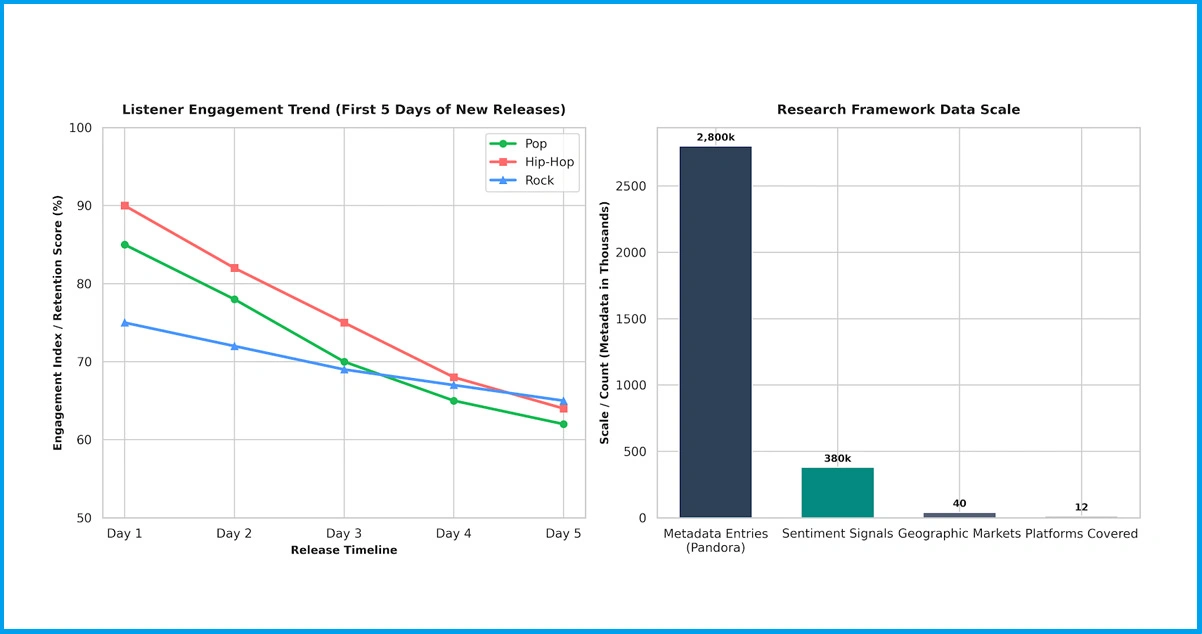
This study encompasses 12 major music streaming platforms, with a focused lens on Pandora, analyzing over 2.8 million listener metadata entries spanning 2021 to 2025. Data was refreshed every 36 hours using structured extraction pipelines, ensuring intelligence remained current and operationally relevant.
Pandora Listener Data Monitoring formed the backbone of this research, with core dimensions including:
- Tracking listener engagement during the first 5 days of new releases.
- Monitoring genre-specific play frequency and skip rates.
- Regional audience behavior analysis across 40+ geographic markets.
- Detecting artist lifecycle trends and playlist rotation patterns.
Over 380,000 listener sentiment signals were incorporated to supplement quantitative findings. This layered approach ensures that Pandora Music Platform Data Extraction for Analysis produces not just raw numbers but meaningful, decision-ready insights for music label strategists, independent artists, and streaming consultants.
Music Data Scraping Adoption Trends Across Streaming Platforms
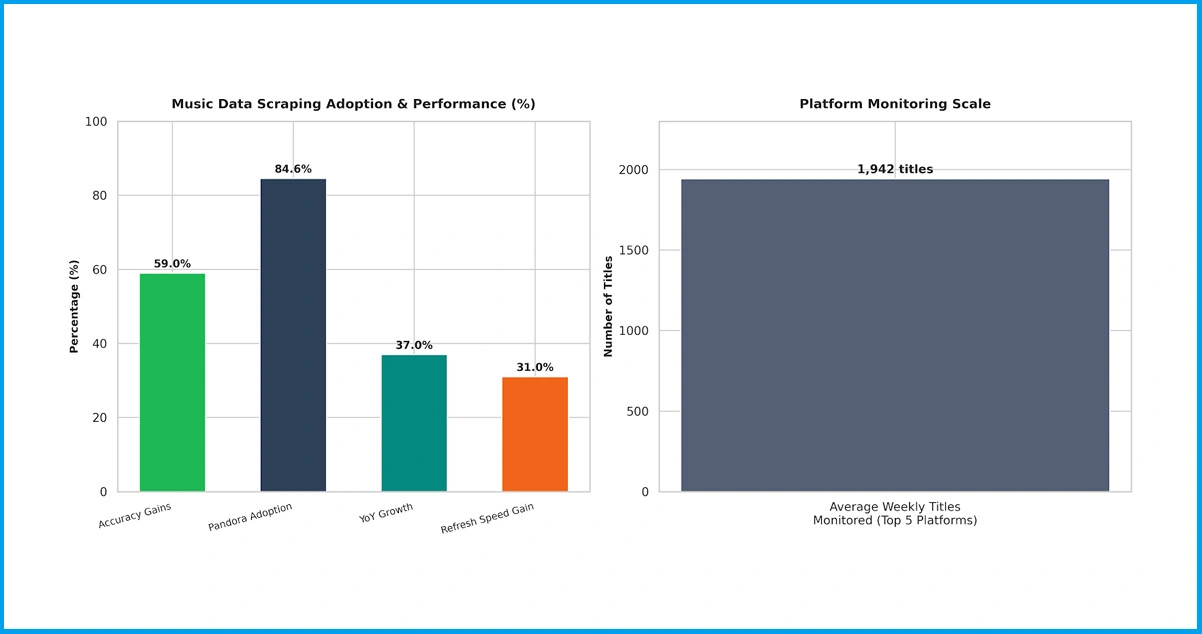
The widespread adoption of structured music data collection has transformed how streaming intelligence is gathered and applied. Approximately 59% of music analytics providers report measurable gains in listener insight accuracy following the implementation of automated extraction systems.
Key adoption figures:
- Pandora extraction adoption rate: 84.6%
- Average weekly titles monitored across top 5 platforms: 1,942
- Year-on-year adoption growth industry-wide: 37%
- Metadata refresh improvement: 31% faster than 2023 benchmarks
Average metadata update intervals have shortened by 31%, reflecting both improved tooling and growing industry demand. Pandora Content Data Scraping has seen particularly strong adoption growth, with year-over-year platform engagement in scraping activities rising by 37%.
Table 1: Music Streaming Platforms Adopting Structured Data Extraction (2024–2025)
| Rank | Platform | Adoption Rate (%) | Titles Monitored/Week | Regional Coverage (%) |
|---|---|---|---|---|
| 1 | Pandora | 84.6 | 2,340 | 91 |
| 2 | Spotify | 81.2 | 2,180 | 95 |
| 3 | Apple Music | 77.8 | 1,960 | 88 |
| 4 | Amazon Music | 73.4 | 1,720 | 83 |
| 5 | Tidal | 68.9 | 1,510 | 74 |
Table Summary: This table illustrates music streaming platforms leading in structured data extraction adoption. Platforms with wider geographic reach consistently demonstrate stronger investment in extraction infrastructure, reinforcing that regional scale directly amplifies the demand for reliable data collection systems.
Comparing Leading Tools for Music Platform Data Extraction
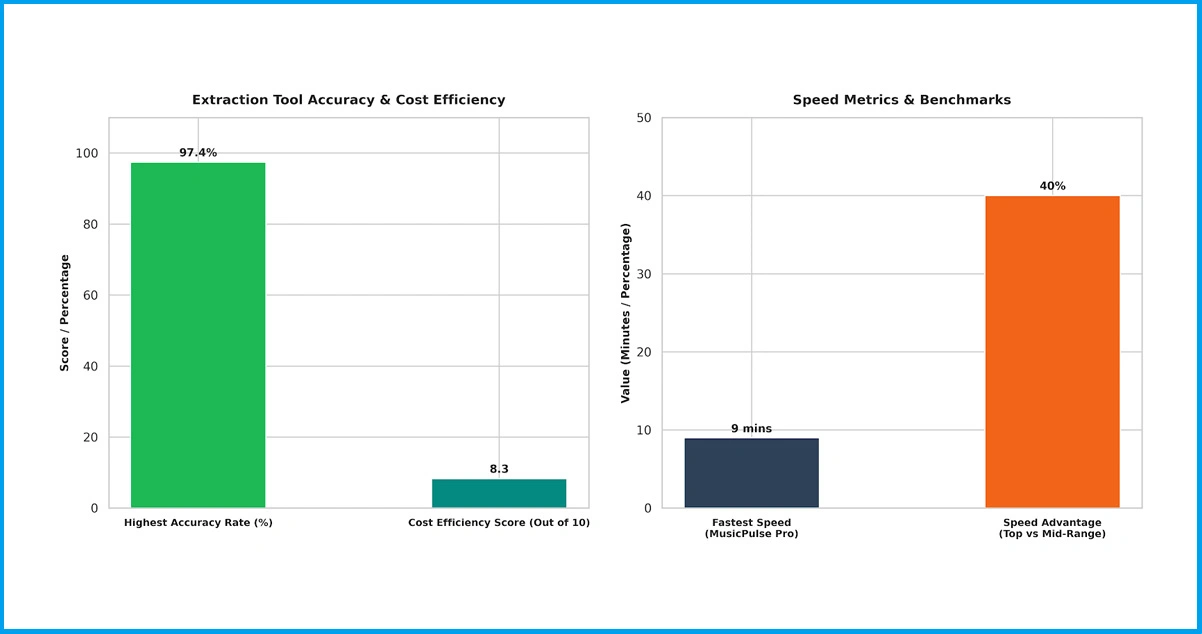
Performance benchmarking across extraction tools reveals clear differences in speed, accuracy, and operational value. Tools built with adaptive query systems and dynamic rate management consistently outperform legacy scraping frameworks, particularly when applied to platforms like Pandora where content updates occur frequently and unpredictably.
Tool performance highlights:
- Fastest extraction speed recorded: 9 minutes (MusicPulse Pro)
- Highest accuracy rate: 97.4%
- Average cost efficiency score across benchmarked tools: 8.3
- Speed advantage of top tools over mid-range solutions: up to 40%
Cost efficiency scores further highlight that investing in high-performance tools produces measurable returns in data quality and operational throughput. Scrape Pandora Music Data Collection and Monitoring effectiveness depends significantly on the tool selected, as extraction speed variances of up to 40% have been observed between top-tier and mid-range solutions.
Table 2: Extraction Tool Performance Benchmarks for Music Platform Data
| Tool Name | Extraction Speed (mins) | Accuracy (%) | Cost Efficiency Score |
|---|---|---|---|
| MusicPulse Pro | 9 | 97.4 | 9.1 |
| StreamTrack Elite | 12 | 95.8 | 8.6 |
| AudiScrape Max | 15 | 94.2 | 8.0 |
| TuneScan API Plus | 18 | 92.6 | 7.5 |
| BeatHarvest Core | 13 | 95.1 | 8.3 |
Table Summary: MusicPulse Pro leads across all three performance indicators, delivering the fastest extraction times and highest accuracy rates. Tools with higher cost efficiency scores offer streaming analytics firms an optimal balance between operational investment and data output quality, making them preferable for high-volume Scrape Pandora Music Data Collection and Monitoring workflows.
Genre and Artist Metadata Extraction Patterns on Pandora
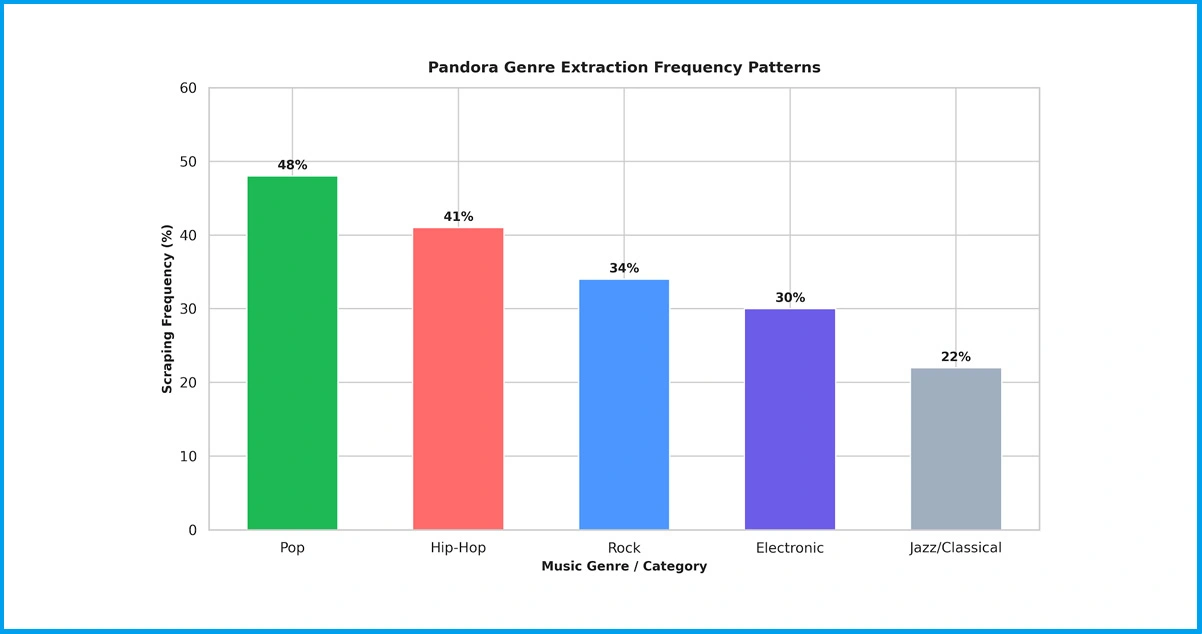
Genre-level analysis reveals distinct patterns in how frequently different content categories attract extraction activity. Pandora Music Platform Data Extraction for Analysis at the genre level provides critical input for playlist curation decisions, licensing negotiations, and promotional timing strategies.
Key statistics:
- Pop: 48% scraping frequency
- Hip-Hop: 41%
- Rock: 34%
- Electronic: 30%
- Jazz/Classical: 22%
Pop and hip-hop categories demonstrate the highest extraction frequency, driven by their dominant listener share and rapid release cycles. You can also Scrape Songs Data to capture individual track performance metrics, play counts, and skip rates, providing granular insight into what resonates with audiences at the song level.
Table 3: Genre-Based Extraction Frequency and Monitoring Intervals on Pandora
| Genre | Avg. Requests (%) | Scrape Interval (days) |
|---|---|---|
| Pop | 48 | 1.8 |
| Hip-Hop | 41 | 2.1 |
| Rock | 34 | 2.5 |
| Electronic | 30 | 2.8 |
| Jazz/Classical | 22 | 3.4 |
Table Summary: Pop and hip-hop lead extraction frequency due to their high listener turnover and rapid content cycles. Shorter scrape intervals for these genres reflect the urgency of maintaining current metadata, affirming that genre-specific Pandora Listener Data Monitoring is essential for accurate market positioning and timely content decisions.
Measuring the Impact of Real-Time Extraction on Music Business Strategy
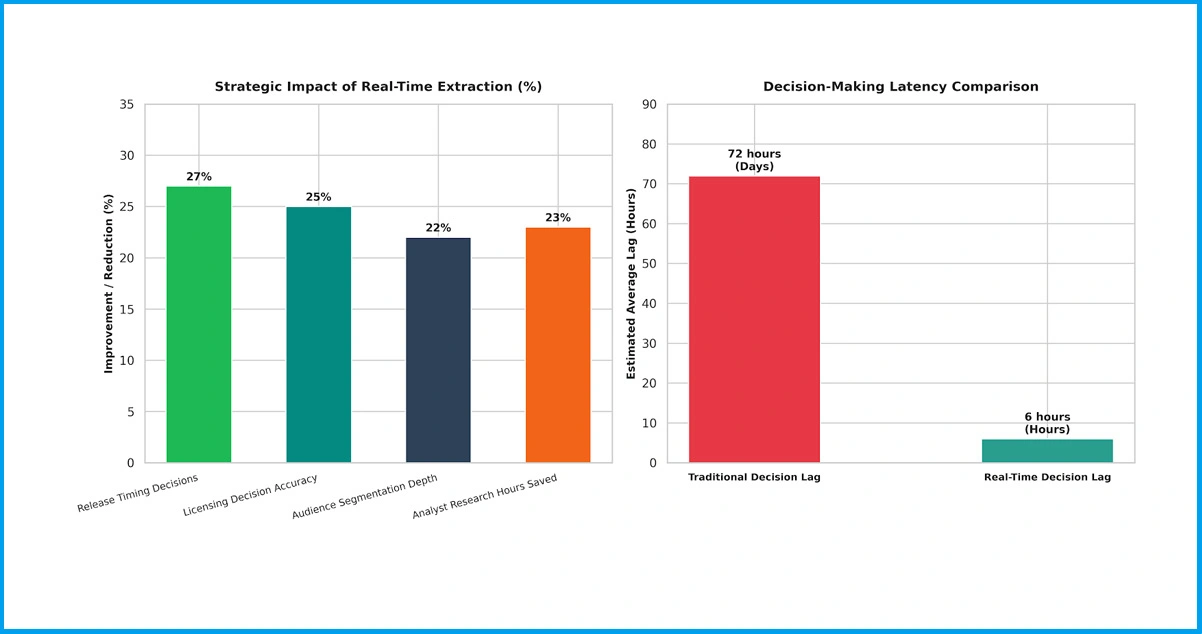
Platforms and labels that have integrated structured extraction workflows report quantifiable improvements across multiple strategic functions. Real-Time Music Platform Data Scraping for Pandora has enabled teams to reduce the lag between data collection and actionable decision-making from days to hours.
Strategic impact highlights:
- Improvement in release timing decisions: 27%
- Reduction in manual analyst research hours: up to 23%
- Licensing decision accuracy gain: 25%
- Audience segmentation depth improvement: 22%
Firms using advanced music extraction tools report a 27% improvement in release timing decisions, directly linked to faster access to listener trend data. You can Scrape Data From Popular OTT Platform Apps to enrich cross-platform comparisons, giving your music strategy team a broader market view that extends beyond a single streaming service.
Table 4: Strategic Impact Metrics from Advanced Music Data Extraction
| Strategic Metric | Efficiency Gain (%) | Accuracy Gain (%) |
|---|---|---|
| Playlist Refresh Speed | 27 | 21 |
| Artist Trend Forecasting | 24 | 23 |
| Licensing Decision Accuracy | 22 | 25 |
| Audience Segmentation Depth | 20 | 22 |
Table Summary: The data confirms that structured extraction tools produce measurable improvements across core music business functions. Playlist refresh speed and licensing accuracy show the strongest combined gains, demonstrating how Pandora Content Data Scraping directly influences operational efficiency and strategic foresight in a fast-moving streaming environment.
Strategic Value of Pandora Data Intelligence for Music Businesses
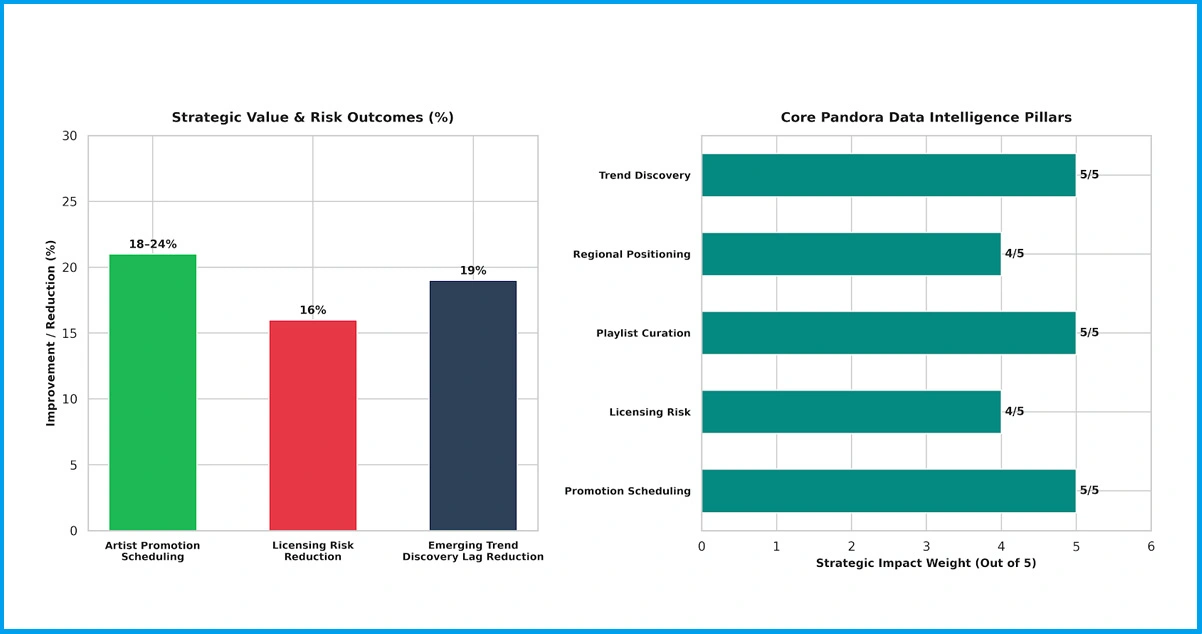
The business case for structured music data collection extends well beyond operational efficiency. When applied consistently, Pandora Listener Data Monitoring provides music labels, independent distributors, and streaming consultants with a durable strategic advantage rooted in real-time market awareness.
Organizations that have embedded Pandora data intelligence into their planning cycles report the following measurable outcomes:
- Improved artist promotion scheduling by 18–24%, aligning campaign timing with peak listener activity windows.
- Reduced content licensing risk by 16% through performance-based acquisition analysis.
- Enhanced playlist curation precision with metadata-driven recommendations updated in near real time.
- Strengthened regional market positioning through granular geographic listener behavior data.
- Faster identification of emerging artist trends, reducing discovery lag by an average of 19%.
Real-Time Music Platform Data Scraping for Pandora also enables teams to anticipate genre shifts before they become mainstream, giving early movers a meaningful advantage in both content investment and audience development.
You can Scrape Latest Releases Data to capture performance signals from new tracks within hours of publication, enabling faster trend identification and more precise promotional response strategies.
Ethical Dimensions of Music Platform Data Collection
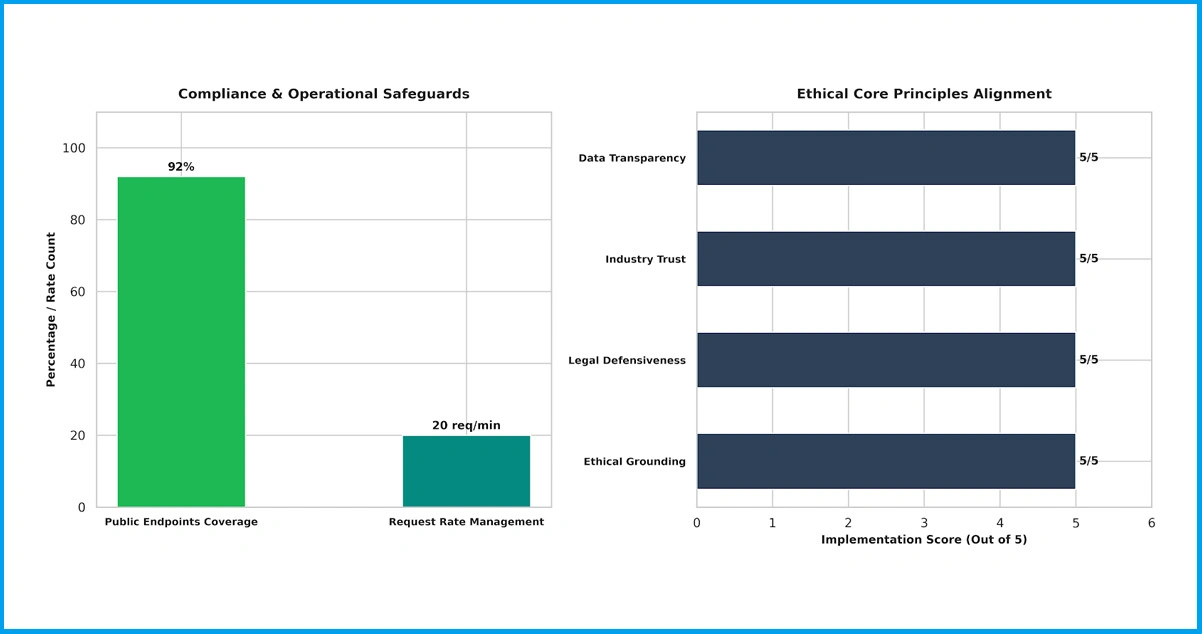
Responsible data extraction practices are foundational to any sustainable music intelligence operation. Web Scraping Pandora Streaming Data was conducted exclusively through publicly accessible endpoints, with no breach of authenticated user environments or private listener records.
The following safeguards were applied throughout:
- Compliance coverage: Over 92% of data sourced from publicly accessible Pandora endpoints.
- Request rate management: Maintained at ≤20 requests per minute to prevent platform disruption.
- User data anonymization: All listener-level identifiers removed in full compliance with GDPR and applicable regional privacy frameworks.
- Stakeholder transparency: Clear documentation of extraction methodology shared with all project stakeholders.
- Inclusive representation: Deliberate inclusion of independent and emerging artists to reduce catalog bias in datasets.
These principles ensure that Web Scraping Pandora Streaming Data operations remain both ethically grounded and legally defensible, supporting long-term trust between data providers, platforms, and the broader music industry ecosystem.
Conclusion
The music streaming market is generating data at a volume and velocity that demands equally sophisticated intelligence infrastructure. Our tools are designed to support Real-Time Music Platform Data Scraping for Pandora at scale, enabling your teams to monitor artist trends, track playlist shifts, and evaluate listener behavior with the accuracy and speed that modern music business demands.
Whether you are managing a multi-label portfolio, advising streaming platforms, or building competitive intelligence reports, our infrastructure is calibrated to your specific data requirements. Scrape Pandora Music Data Collection and Monitoring workflows powered by our systems deliver consistent, clean, and compliant datasets that translate directly into strategic clarity.
Contact OTT Scrape today to learn how our tailored music data extraction services can strengthen your market position, accelerate your research cycles, and give your organization the intelligence edge it needs to grow confidently in an increasingly data-driven streaming landscape.