
Introduction
Streaming platforms continuously expand their libraries across movies, series, documentaries, originals, regional productions and international titles. Comparing these catalogs requires structured metadata covering genres, languages, ratings, release years, runtimes and content types. Amazon Prime Movie Datasets can support detailed catalog comparisons by organizing these attributes into consistent analytical records.
A structured approach also helps businesses examine how content availability changes between platforms. Genre distribution, language diversity, rating patterns and release frequency can reveal differences in catalog composition. Comparing these attributes provides useful information for researchers, media analysts, content strategists and businesses evaluating streaming-market movements.
With OTT Web Scraping for Metadata Analysis, analysts can collect comparable information from multiple streaming platforms and organize it into standardized datasets. This approach supports trend identification across Amazon Prime, Netflix and JioHotstar while reducing the effort involved in manually reviewing large and frequently changing catalogs.
Decoding Catalog Signals Through Cross-Platform Streaming Content Patterns
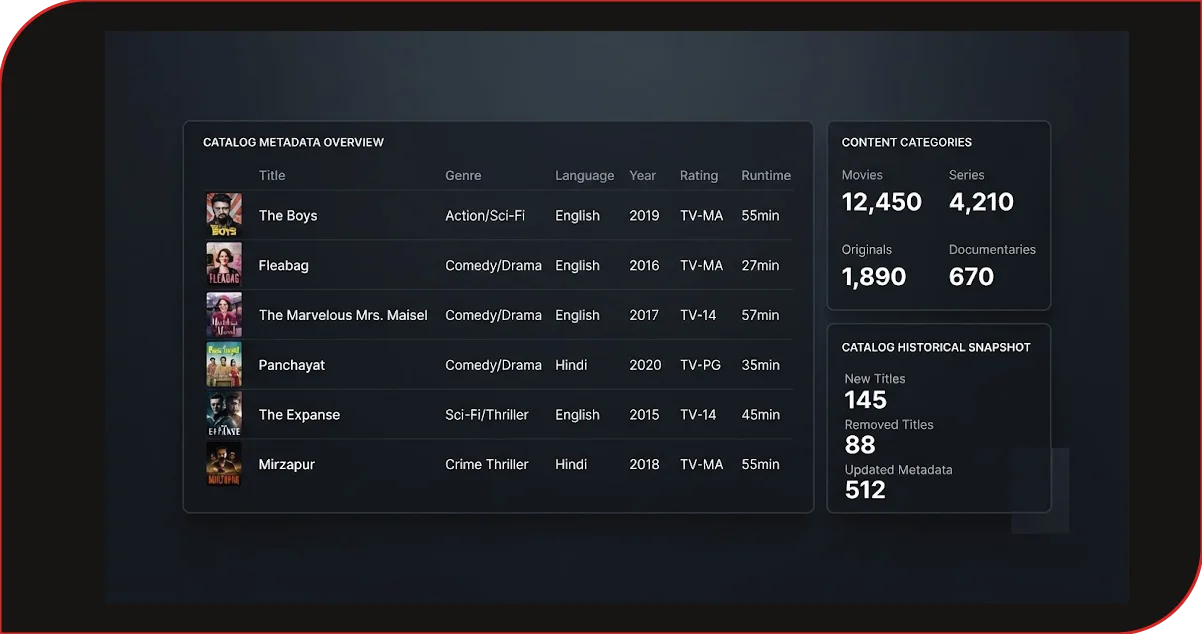
Streaming catalogs contain extensive metadata that can reveal how platforms organize movies, series, originals, documentaries, and regional productions. Comparing title counts, genres, languages, ratings, release years, and runtimes create a structured foundation for identifying differences in catalog composition. This information can also help analysts evaluate how content categories are distributed across major streaming services.
For Amazon Prime, structured Amazon Prime Data Scraping can collect title-level information and arrange it according to consistent metadata fields. Analysts can then compare content categories, language availability, release periods, and audience ratings without manually examining individual listings. Historical snapshots can further help identify changes in catalog composition and shifts in the types of content appearing across different periods.
Another important layer involves organizing information collected through Amazon Prime Video Data Scraping into standardized datasets. These datasets can connect title attributes with broader analytical dimensions, such as content format, production language, genre, release year, and rating. Such organization makes it easier to create dashboards and compare recurring metadata patterns across multiple catalog snapshots.
| Analysis Area | Sample Coverage | Research Purpose |
|---|---|---|
| Content Types | 4+ | Format comparison |
| Genre Groups | 25+ | Category analysis |
| Languages | 20+ | Regional coverage |
| Release Periods | 20+ years | Historical comparison |
Key analytical activities include:
- Comparing genre distribution across catalog periods
- Monitoring changes in language availability
- Grouping movies and series by release year
- Reviewing rating patterns across content categories
- Building structured metadata dashboards
A structured catalog analysis can support several practical research activities, including competitive monitoring, content planning, market research, and regional programming analysis. Analysts can combine multiple metadata fields to identify frequently represented genres, changing language mixes, and variations in release activity. The following sample structure demonstrates how catalog information can be arranged for comparative analysis.
Mapping Genre Movements Across Expanding Digital Entertainment Libraries
Netflix catalogs contain diverse movies, series, documentaries, and original productions that can be examined through standardized metadata. Fields such as genre, language, rating, release year, runtime, and content type provide measurable attributes for comparing catalog characteristics. Organizing these fields into consistent records makes large-scale content research more manageable for analysts and media intelligence teams.
Using Netflix Movie Datasets, researchers can categorize titles according to release periods, genres, languages, ratings, and content formats. This structure supports comparisons between older and newer content while helping analysts identify recurring categories within the available dataset. Historical records can also provide a foundation for examining how content composition changes across selected periods.
A structured Netflix Web Data Scraper workflow can collect relevant metadata and transform scattered title information into organized records. Analysts can then filter datasets by language, genre, release year, rating, or runtime to conduct more focused research. This approach is particularly useful when the objective is to compare large numbers of titles rather than manually review individual content pages.
| Metadata Category | Sample Dataset Size | Analytical Application |
|---|---|---|
| Movies | 70K+ | Movie catalog analysis |
| Series | 25K+ | Episodic content research |
| Languages | 30+ | Regional analysis |
| Genre Categories | 25+ | Content classification |
Useful analysis activities include:
- Tracking genre frequency over selected periods
- Comparing movie and series distributions
- Grouping titles according to language
- Reviewing rating patterns by content type
- Mapping release activity across years
These structured records can contribute to several analytical applications, including content-market research, competitor monitoring, catalog benchmarking, and regional programming studies. Combining multiple metadata attributes can reveal relationships between release periods, genres, languages, and ratings. The following table presents an illustrative framework for organizing Netflix-related catalog information for analytical purposes.
Regional Content Signals Shaping Diverse Streaming Catalog Structures
Regional diversity is an important metadata dimension when examining streaming catalogs across different markets. JioHotstar contains content that can be categorized through language, genre, content format, rating, release year, and runtime. Structuring these attributes allows analysts to examine how regional and broader entertainment categories are represented within a streaming catalog.
Through Jiohotstar Data Extraction, title-level metadata can be organized into consistent records covering language, genre, release period, rating, and content type. This structure can support comparisons between regional categories and broader catalog segments. Analysts can also use historical snapshots to examine how the composition of available content changes over selected periods.
Recurring collection through Jiohotstar Data Scraping Services can provide refreshed metadata for organizations conducting continuous catalog research. Instead of relying on one static dataset, scheduled collections can create successive snapshots that allow analysts to compare changes in titles, categories, languages, and release activity. These records can also be integrated into analytical systems for recurring monitoring.
| Metadata Field | Illustrative Coverage | Analytical Purpose |
|---|---|---|
| Regional Languages | 15+ | Language comparison |
| Genre Categories | 20+ | Content classification |
| Content Formats | 4+ | Format analysis |
| Release Years | 20+ | Historical research |
Key research activities include:
- Mapping regional language distribution
- Comparing genre representation
- Monitoring new and older releases
- Categorizing content by format
- Tracking rating and runtime variations
Structured streaming information can support content research, regional market analysis, competitor comparisons, and catalog intelligence. Analysts can combine language and genre fields to identify frequently represented categories while release-year information can provide historical context. A standardized dataset also makes it easier to compare JioHotstar information with similarly structured records from other streaming platforms.
How OTT Scrape Can Help You?
We can structure large volumes of streaming metadata into consistent datasets for research and comparative analysis. With OTT Web Scraping for Metadata Analysis, businesses can organize catalog information across platforms and examine changes in genres, languages, ratings, release years and content formats through repeatable collection workflows.
Key capabilities include:
- Multi-platform metadata collection
- Automated catalog structuring
- Genre and language classification
- Release-year trend tracking
- Rating and runtime organization
- Recurring dataset refreshes
The resulting datasets can support dashboards, market research, competitive analysis, recommendation models and content strategy workflows. Analysts can also combine historical snapshots to identify changes in catalog composition over time. Scrape OTT Movie and Series Data workflows can provide structured records that are easier to filter, compare and integrate with internal analytics systems.
Conclusion
Comparing Amazon Prime, Netflix and JioHotstar becomes more practical when metadata is collected using consistent fields and repeatable processes. OTT Web Scraping for Metadata Analysis can organize genres, languages, ratings, release years and content types into comparable datasets, helping analysts examine catalog structures and changing content patterns across multiple streaming services.
Structured Netflix Web Data Scraper datasets can also support recurring research, historical comparisons and platform-level metadata studies. When refreshed at defined intervals, these datasets can provide a consistent foundation for dashboards, market research and content intelligence initiatives. Contact OTT Scrape today to build structured streaming metadata datasets for your analysis needs.