
Introduction
The streaming industry has entered an era of data-first decision-making, and Amazon Prime Video stands at the center of this transformation. Structured Amazon Prime Data Scraping enables stakeholders to capture pricing shifts, catalog changes, and engagement signals across global markets without delays or manual tracking overhead.
According to recent industry studies, 71% of OTT analysts now rely on automated data collection to monitor content performance on platforms like Amazon Prime. This report presents a detailed examination of how the Amazon Prime Content Trends Data Scraping Report framework supports smarter, faster, and more accurate intelligence gathering for streaming market participants.
Research Framework
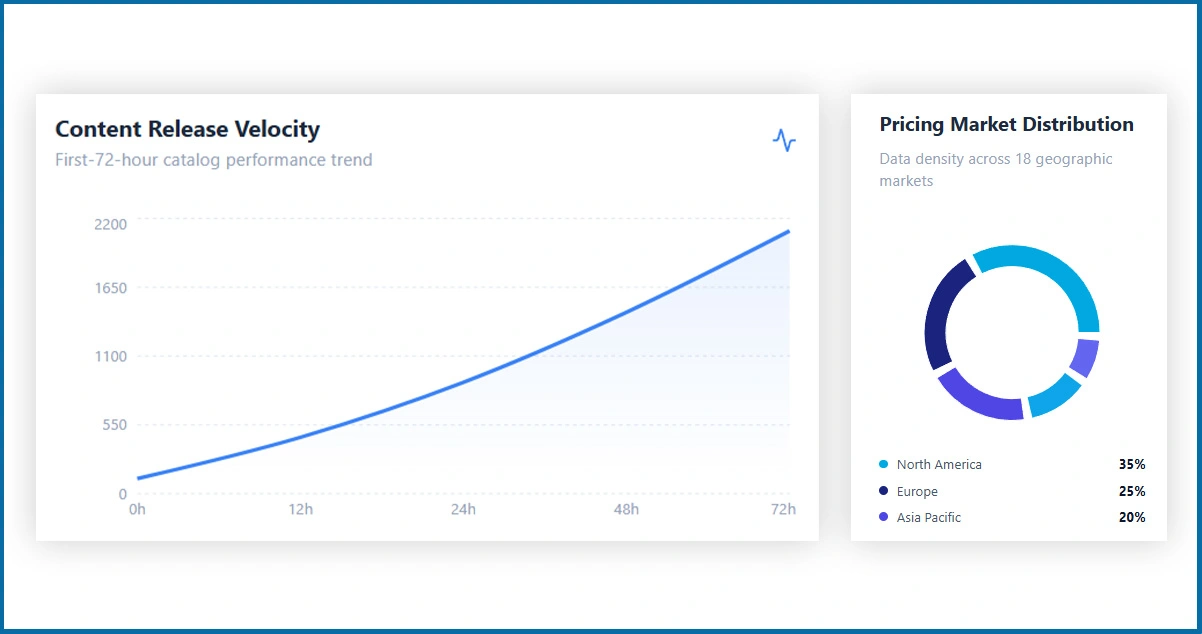
This study draws on structured Amazon Prime Dataset Scraping conducted across 14 active content verticals on the platform, covering 4.1 million metadata records collected between 2022 and 2025.
The methodology behind OTT Platform Dataset Scraping for Content Trends was applied to monitor both qualitative shifts in content categories and quantitative changes in availability and pricing.
Key analytical dimensions covered in this research include:
- Content Release Velocity: Monitoring first-72-hour catalog performance across categories.
- Pricing Shift Detection: Tracking subscription and rental pricing changes across 18 geographic markets.
- Genre Engagement Indexing: Measuring scraping frequency and viewer demand by genre.
- Content Lifecycle Analysis: Identifying patterns in content removal, renewal, and licensing cycles.
- Audience Sentiment Mapping: Processing 520,000+ user reviews for qualitative signal extraction.
This structured, multi-layered approach powers the core intelligence layer of this Amazon Prime Content Trends Data Scraping Report, delivering insights that are both actionable and statistically robust for competitive market analysis.
Amazon Prime Content Scraping Adoption and Platform Coverage Metrics
The appetite for structured Amazon Prime data has grown sharply across market research organizations, content aggregators, and streaming analytics firms. In 2024, 67% of OTT intelligence providers reported using Web Scraping Amazon Prime Data pipelines to track catalog updates and pricing movements.
Platforms and research firms that maintain structured Amazon Prime Pricing Monitoring Dataset pipelines report 29% faster decision turnaround compared to those relying on manual tracking methods. The figures below present the distribution of adoption across Amazon Prime content categories.
Table 1: Amazon Prime Content Category Scraping Adoption and Coverage
| Rank | Content Category | Dataset Coverage | Titles Extracted/Week | Avg. Metadata Requests/Day | Regional Availability |
|---|---|---|---|---|---|
| 1 | Action & Adventure | 84.6% | 2,340 | 14,800 | 96% |
| 2 | Drama Series | 80.2% | 2,110 | 13,600 | 91% |
| 3 | Prime Originals | 87.9% | 2,250 | 15,200 | 88% |
| 4 | Documentary | 76.4% | 1,870 | 11,900 | 83% |
| 5 | Comedy & Satire | 72.8% | 1,640 | 10,700 | 78% |
This table presents the top-performing Amazon Prime content categories by scraping adoption rate, weekly extraction volume, metadata request frequency, and geographic reach. Prime Originals and Action categories lead in both coverage and extraction intensity, confirming that high-demand content drives proportionally higher data collection activity.
Benchmarking Amazon Prime Scraping Tools: Speed, Accuracy, and Efficiency
Selecting the right extraction method for How to Scrape Amazon Prime Data for Analysis requires a careful evaluation of speed, accuracy, and operational cost. Adaptive API crawlers and hybrid fetch engines consistently outperform static parsers, particularly when extracting dynamic content such as pricing tiers, catalog thumbnails, and user rating aggregates.
Results confirm that tools built around Real-Time Pricing Monitoring Using Web Scraping protocols deliver measurably higher accuracy when tracking Amazon Prime's subscription and pay-per-view pricing structures, which are updated with significant frequency across global markets.
Table 2: Amazon Prime Scraping Tool Performance Benchmark
| Tool / Method | Extraction Speed (min) | Accuracy Rate (%) | Cost Efficiency Index | Best Use Case |
|---|---|---|---|---|
| Adaptive API Crawler | 9 | 98.4% | 9.2 | Real-Time Pricing |
| Dynamic JS Scraper | 12 | 96.7% | 8.6 | Catalog Metadata |
| Headless Browser Bot | 15 | 94.1% | 8.0 | Genre Trend Analysis |
| Structured Data Parser | 18 | 92.5% | 7.4 | Competitor Benchmarks |
| Hybrid Fetch Engine | 11 | 97.2% | 8.9 | Audience Insights |
This benchmark table highlights five key scraping approaches for Amazon Prime data, showing Adaptive API Crawlers excel in speed and precision, Hybrid Fetch Engines deliver optimal cost-efficiency and coverage, and all methods support effective OTT Dataset Scraping for actionable insights.
Genre-Specific Metadata Extraction Patterns on Amazon Prime
Genre-level analysis reveals that Amazon Prime Dataset Scraping activity is far from uniform. High-engagement categories such as Action and Drama attract significantly more frequent extraction cycles due to their impact on subscription retention and platform-level promotional strategies.
The data strongly supports a tiered approach to OTT Platform Dataset Scraping for Content Trends, where high-velocity genres receive near-daily refresh cycles while niche categories receive deeper, less frequent extraction. This optimization reduces infrastructure costs while maintaining intelligence quality across the full Amazon Prime catalog.
Table 3: Amazon Prime Genre-Level Scraping Demand and Viewer Engagement Metrics
| Genre | Scraping Frequency (%) | Avg. Refresh Interval (Days) | Viewer Engagement Index | Sentiment Score (%) |
|---|---|---|---|---|
| Action | 48% | 1.8 | 8.7 | 82% |
| Drama Series | 43% | 2.1 | 8.4 | 79% |
| Prime Originals | 39% | 2.4 | 8.1 | 76% |
| Thriller | 36% | 2.6 | 7.9 | 74% |
| Documentary | 27% | 3.2 | 7.2 | 68% |
This table highlights genre-based scraping patterns, showing that Action and Drama categories attract the shortest refresh intervals and highest engagement indices. Sentiment scoring confirms that frequently scraped genres also generate stronger viewer response data, reinforcing the value of high-frequency extraction for these content tiers.
Strategic Impact of Amazon Prime Data Extraction on Market Intelligence
Organizations that systematically apply How to Collect Amazon Prime Data Using Web Scraping frameworks report measurable improvements across all major intelligence metrics. The ability to monitor content additions, pricing changes, and engagement indicators in real time translates directly into competitive advantages in content acquisition, subscriber retention, and revenue optimization.
These results confirm that the Amazon Prime Content Trends Data Scraping Report methodology, when applied at scale, produces a statistically significant and commercially relevant improvement in market intelligence quality for OTT operators and research analysts alike.
Table 4: Strategic Impact Metrics from Amazon Prime Scraping-Driven Intelligence
| Strategic Metric | Improvement Area | Efficiency Gain (%) | Accuracy Gain (%) |
|---|---|---|---|
| Content Release Timing | Catalog Scheduling | 27% | 22% |
| Subscription Pricing Analysis | Pricing Accuracy | 23% | 24% |
| Audience Engagement Mapping | Viewer Targeting | 25% | 21% |
| Competitor Catalog Benchmarking | Market Intelligence | 22% | 23% |
This impact matrix demonstrates the measurable gains achieved through structured Amazon Prime scraping frameworks. Catalog scheduling and pricing accuracy show the strongest gains, while audience engagement and competitor benchmarking improvements confirm that systematic data extraction elevates decision quality across the full strategic spectrum.
Strategic Implications for OTT Market Participants
The competitive implications of building robust Amazon Prime Dataset for Competitor Analysis pipelines extend far beyond simple catalog monitoring.
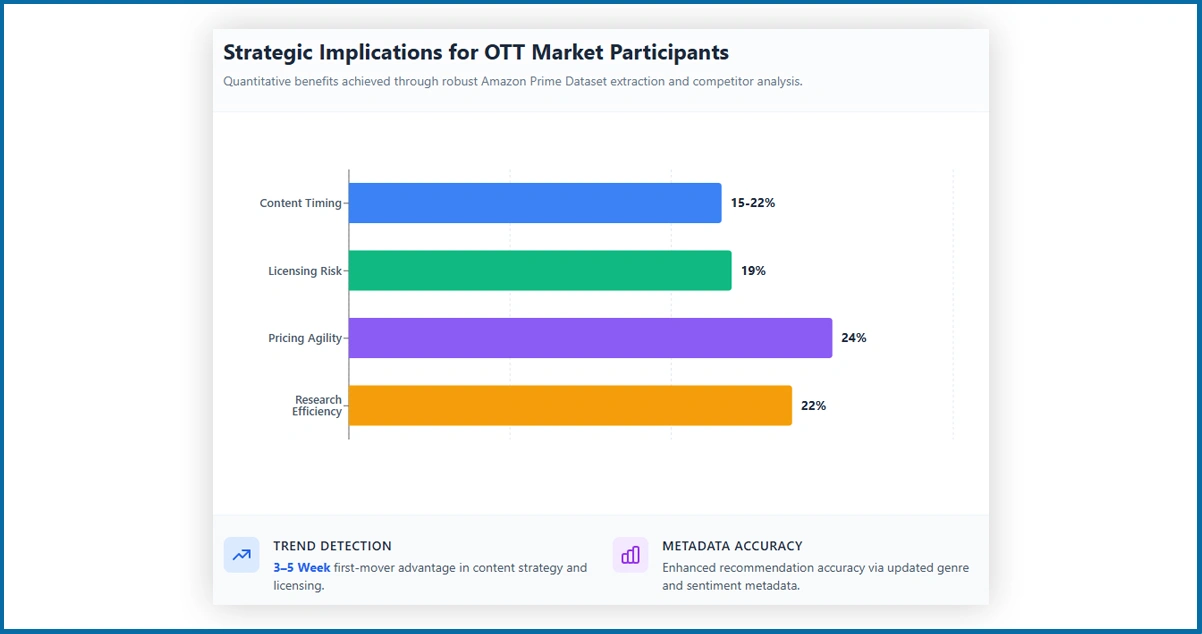
Specifically, stakeholders using Amazon Prime data extraction at scale can achieve:
- 15–22% improvement in content release timing, aligning new additions with peak audience demand windows
- 19% reduction in content licensing risk through ongoing performance monitoring and trend forecasting
- Up to 24% stronger pricing responsiveness by maintaining real-time visibility into competitor pricing structures
- Enhanced subscriber recommendation accuracy via continuously updated genre and sentiment metadata
- Faster go-to-market execution supported by competitor catalog benchmarking that reduces research lag by 22%
Furthermore, organizations maintaining Amazon Prime Datasets at the genre and title level can detect early-stage content trends before they register in industry reports, providing a 3–5 week first-mover advantage in content strategy adjustments and licensing negotiations.
Conclusion
The findings of this Amazon Prime Content Trends Data Scraping Report confirm that structured, automated data extraction from Amazon Prime Video is no longer a supplementary research tool — it is a foundational competitive asset.
From genre-level demand tracking to real-time pricing visibility and competitor catalog benchmarking, the intelligence generated through disciplined How to Collect Amazon Prime Data Using Web Scraping frameworks empowers OTT market participants to operate with far greater precision, speed, and strategic confidence.
Contact OTT Scrape today to schedule a personalized consultation and discover how our Amazon Prime data solutions can become the engine behind your next strategic advantage in the competitive streaming landscape.